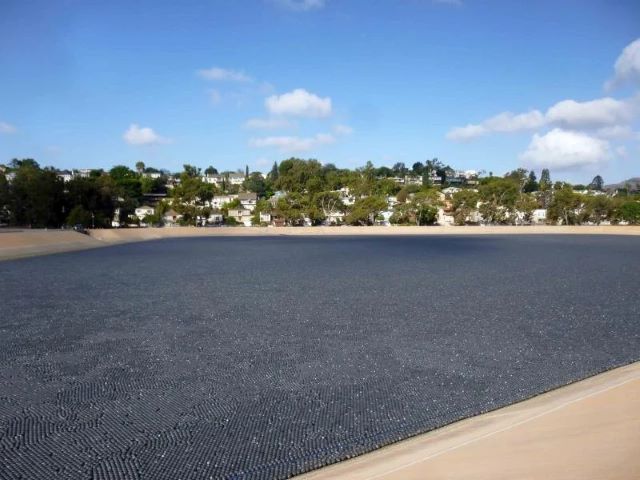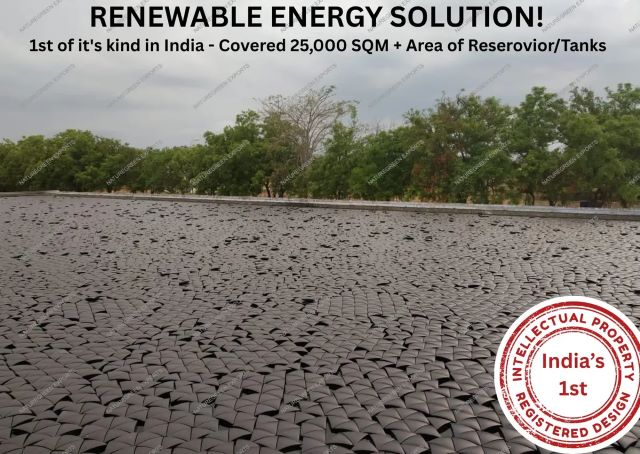
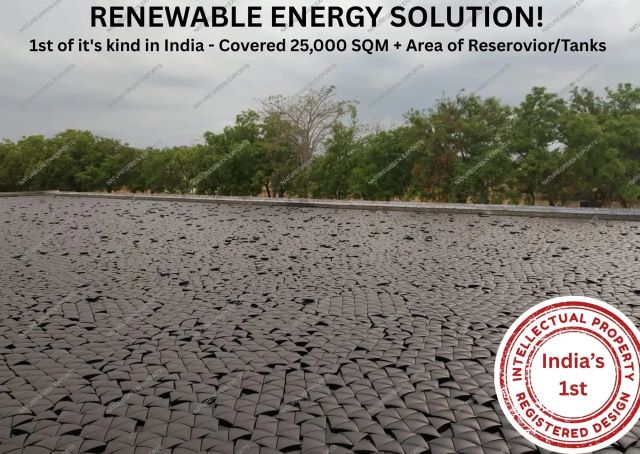
Designing a reliable floating cover system for large-scale industrial wastewater lagoons, sewage maturation ponds, and equalization basins requires accurate calculation of liquid surface areas, packing geometries, wind shear anchoring, and sludge management. Unlike standard architectural roofs, lagoon covers must withstand extreme weather, fluctuating liquid levels, and aggressive biological chemistry over decades of outdoor service. This comprehensive technical guide provides plant engineers and EPC consultants with step-by-step sizing methodologies, packing density formulas, and material selection criteria.
1. Lagoon Geometry & Liquid Surface Area Calculation
Wastewater lagoons are typically constructed with sloped earthen embankments (side slopes ranging from 1:2 to 1:3 vertical-to-horizontal). Because liquid levels fluctuate between Maximum Operating Level (MOL) and Low Operating Level (LOL), the effective water surface area varies continuously.
For a rectangular lagoon with side slopes, calculate surface area at maximum operating level (Amax):
Amax = [Lbottom + 2 × (z × H)] × [Wbottom + 2 × (z × H)]
Where L_{bottom} and W_{bottom} are basin bottom dimensions (m), H is liquid depth (m), and z is the horizontal slope ratio (e.g., z=3 for a 1:3 slope).
Design Rule: Sizing must always be calculated based on Maximum Operating Surface Area (Amax) to ensure complete 90%–95% coverage when the lagoon is at peak capacity.
2. Packing Density & Unit Quantity Formulas
Depending on whether modular triangle tiles or hollow spherical balls are selected, unit requirements per square meter follow precise geometric packing rules:
| Cover System Type | Unit Diameter / Size | Surface Coverage | Packing Density (Units / m²) | Total Units for 5,000 m² Lagoon |
|---|---|---|---|---|
| NatureGreen Triangle Covers | Modular Hex/Triangle | 90% – 95% | ~35 units / m² | 175,000 units |
| 100mm HDPE Hollow Balls (Single) | 100mm (4-Inch) | 91% | 116 balls / m² | 580,000 balls |
| 100mm HDPE Hollow Balls (Double) | 100mm (4-Inch) | 98% | 232 balls / m² | 1,160,000 balls |
| 75mm HDPE Hollow Balls | 75mm (3-Inch) | 91% | 205 balls / m² | 1,025,000 balls |
| 50mm HDPE Hollow Balls | 50mm (2-Inch) | 91% | 462 balls / m² | 2,310,000 balls |
Explore full dimensions on Hollow Triangle Floating Covers and 100mm HDPE Hollow Balls.
3. Handling Embankment Slopes & Irregular Geometries
Unlike rigid sheet geomembranes that stretch and tear when water levels drop, modular floating systems adjust automatically:
- Beaching on Slopes: As water levels recede during heavy pumping, perimeter tiles rest gently on riprap or HDPE-lined banks. When the water refuels, the units refloat smoothly without creasing or puncturing.
- Navigation Around Aerators & Piles: Symmetrical floating tiles flow around fixed guide piles, floating surface aerators, and intake skimmers without requiring customized edge cutouts.
4. Wind Stability & Aerodynamic Self-Ballasting
High-velocity wind storms (>80 km/h) present the greatest risk to large-scale lagoon covers. Continuous membranes can balloon and tear under negative wind pressure (uplift forces).
Modular systems prevent wind displacement through aerodynamic self-ballasting:
- Low Surface Profile: The upper curved profile creates negative aerodynamic lift, keeping the cover pressed against the water surface.
- Inter-Tile Symmetrical Interlocking: Adjacent triangle tiles distribute localized wind shear across the entire surface blanket.
- Internal Water Ballasting: Hollow units feature precision internal ballasting chambers that maintain a calibrated center of gravity.
5. Step-by-Step Engineering Specification Checklist
When drafting an engineering tender or procurement specification for lagoon covers, ensure the following technical clauses are included:
- Raw Material: 100% Virgin High-Density Polyethylene (HDPE) blended with minimum 2.0%–2.5% carbon black UV stabilizer (ASTM D1603).
- Service Temperature: Certified continuous operation from -30°C to +80°C without embrittlement or environmental stress cracking.
- Coverage & Performance: Minimum 90% surface blanketing with certified >70% evaporation reduction and >80% VOC/odor emission cut.
- Zero Civil Works: Installation must proceed on an active lagoon without draining or plant shutdown.
Key Engineering Takeaways
- Lagoon sizing must always be based on Maximum Operating Surface Area (A_max) to guarantee full coverage at peak capacity.
- Modular triangle covers require ~35 units/m², while 100mm spherical balls require 116 units/m² (single layer).
- Modular systems rest safely on earthen/lined embankments during drawdowns and refloat seamlessly without mechanical damage.
- Aerodynamic self-ballasting and interlocking distribute wind forces, preventing blow-off during 100+ km/h storms.
Frequently Asked Questions
Covers are shipped in bulk freight containers or heavy-duty sacks. Unloading is conducted directly into the lagoon via staging chutes or crane lifting nets, requiring minimal labor.
A typical 10,000 m² industrial lagoon can be completely covered in 2 to 4 working days with a small staging crew of 3–4 technicians, with zero disruption to active plant operations.
No. Floating covers are engineered for fluid surface blanketing, not as pedestrian platforms. Safety buoyancy rings and standard perimeter life-lines should be maintained around lagoon banks.
Get Custom Lagoon Sizing & CAD Layout Support
Provide your lagoon coordinates and depth profile to NatureGreen engineers for an exact unit count and proposal.
Related Technical Insights