Open water reservoirs, emergency raw water holding basins, and cooling ponds are vital infrastructural assets across thermal power stations, chemical processing plants, and manufacturing complexes. However, in semi-arid and tropical industrial corridors, unmitigated surface evaporation causes substantial water inventory depletion—frequently exceeding 2,000 to 3,000 mm of liquid depth annually. This technical guide examines the thermodynamic physics governing open surface evaporation, outlines empirical loss calculation formulas, and analyzes proven physical mitigation strategies including modular interlocking floating covers.
1. Thermodynamics of Open Water Evaporation
Surface evaporation from open industrial reservoirs is driven by a complex interplay of radiative energy transfer, air-water boundary layer dynamics, and convective mass transfer. The fundamental rate of vaporization is governed by Dalton's Law of Evaporation:
E = (es - ea) × (a + b × W)
Where E represents evaporation rate (mm/day), es is the saturation vapor pressure at water surface temperature (kPa), ea is the actual vapor pressure of the ambient air layer, W is the horizontal wind velocity at surface level (m/s), and a and b are empirical aerodynamic constants.
Three primary climatic drivers accelerate industrial water loss:
- Solar Radiation & Thermal Absorption: Uncovered dark water surfaces absorb up to 94% of incident shortwave solar radiation, elevating epilimnion water temperatures and increasing saturation vapor pressure exponentially.
- Vapor Pressure Deficit (VPD): During hot, dry ambient conditions (>40°C with relative humidity below 30%), the boundary layer gradient
(es - ea)widens dramatically, creating extreme vapor mass suction. - Wind Shear & Boundary Layer Stripping: Wind speeds exceeding 15 km/h continuously strip the saturated microclimate boundary layer above the liquid surface, replacing it with dry ambient air and sustaining maximum evaporation rates.
2. Evaporation Loss Calculation Methodology
To accurately quantify annual water losses, industrial facilities rely on Penman-Monteith energy balance modeling and regional pan evaporation coefficients. In Western and Central India (such as Gujarat and Rajasthan), open pan evaporation benchmarks typically average 8.207 m³ per m² of water surface area per year.
Consider a standard industrial raw water reservoir measuring 110 meters in length by 55 meters in width (surface area = 6,050 m²):
| Parameter | Baseline / Uncovered | With 70% Mitigation | With 85% Mitigation |
|---|---|---|---|
| Reservoir Surface Area | 6,050 m² | 6,050 m² | 6,050 m² |
| Annual Evaporation Rate | 8.207 m³/m²/year | 2.462 m³/m²/year | 1.231 m³/m²/year |
| Annual Water Loss | 49,652.9 m³ (49.65 Million Litres) | 14,895.8 m³ (14.89 Million Litres) | 7,447.9 m³ (7.45 Million Litres) |
| Daily Water Loss (Summer Peak) | 180,000 to 220,000 Litres/day | 54,000 to 66,000 Litres/day | 27,000 to 33,000 Litres/day |
| Annual Cost (@ ₹32/m³ Water Tariff) | ₹1,588,892 / year | ₹476,667 / year | ₹238,333 / year |
* Illustrative Engineering Model: Calculations represent theoretical hydrology estimates for a representative 6,050 m² basin under semi-arid climatic conditions. Actual site water savings and payback periods vary based on local pan evaporation, ambient solar irradiance, wind velocity, and utility water tariffs, and do not constitute a guaranteed performance warranty.
Industrial facility engineers can verify customized site figures using the interactive NatureGreen Evaporation ROI Calculator.
3. Financial & Operational Consequences for Process Plants
The consequences of unmonitored evaporation extend far beyond water utility bills. In process manufacturing and thermal power generation, evaporative losses trigger several secondary operational bottlenecks:
- Total Dissolved Solids (TDS) Concentration: As pure H₂O vaporizes, dissolved minerals (calcium, magnesium, chlorides, sulfates) remain behind, steadily concentrating raw water TDS and increasing scaling tendencies in heat exchangers, cooling towers, and RO membrane pre-treatment lines.
- Raw Water Intake Vulnerability: During severe summer drought periods, local water authorities frequently impose rationing quotas on industrial consumers. Plants losing 15%–30% of their stored water inventory to the atmosphere risk emergency production curtailments.
- Accelerated Chemical Dosing: High reservoir temperatures and prolonged solar exposure stimulate biological fouling and organic slime formation, demanding recurring algaecide and biocide dosing.
4. Technical Comparison of Evaporation Mitigation Technologies
Over the past four decades, various engineering approaches have been developed to curb open water evaporation. Below is an objective technical comparison:
| Technology | Evaporation Cut | Wind Stability | Service Lifespan | Civil Work Required | Maintenance Needs |
|---|---|---|---|---|---|
| Chemical Monolayers (Cetyl Alcohol) | 20% – 35% | Very Poor (<10 km/h breaks film) | Hours to Days (Continuous re-dosing) | None | High (Continuous automated dosing pumps) |
| Continuous Tensioned Geomembranes | 80% – 95% | Moderate (Prone to tearing & ballooning) | 5 – 8 Years | Extensive (Anchor trenches & concrete ballasting) | High (Rainwater pump-off, tear patching) |
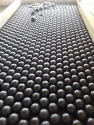
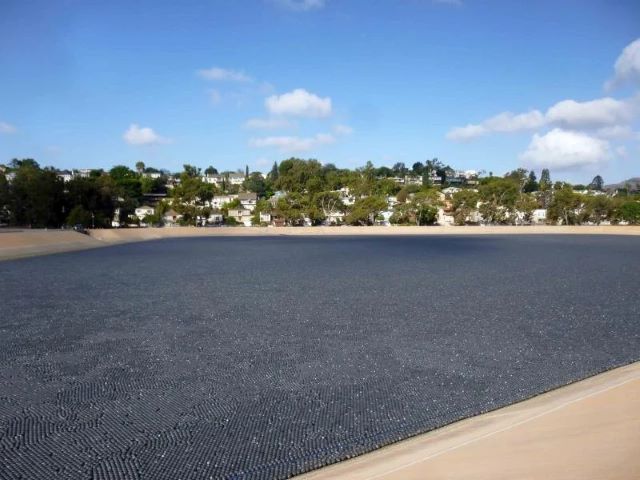
| Shade Ball Systems (100mm HDPE) | 85% – 91% | High (Interlocking ball matrix) | 10 – 15+ Years | Zero (Direct floating deployment) | Virtually Zero (Self-leveling) |
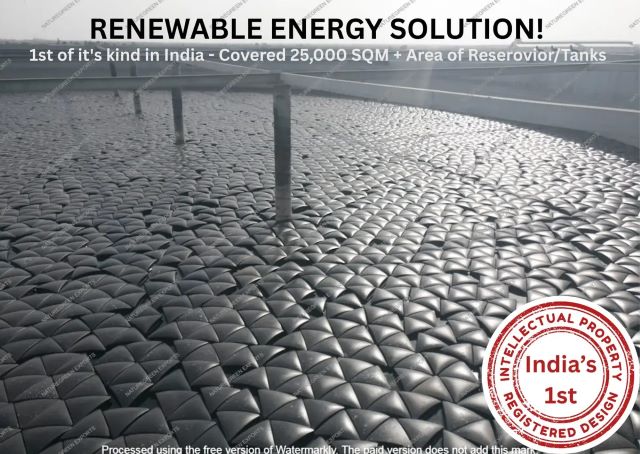
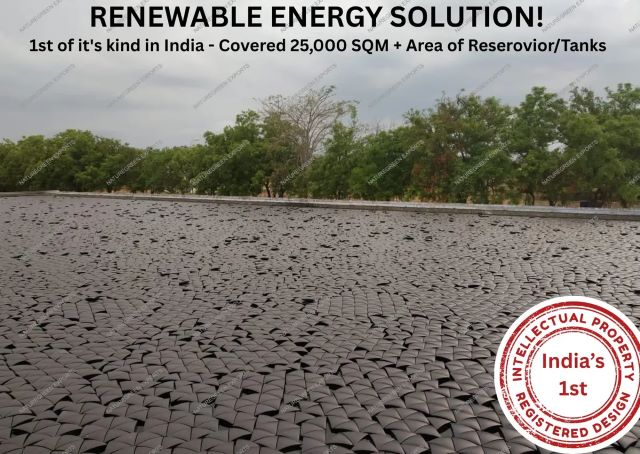
| Modular HDPE Triangle Floating Covers | 70% – 85%+ | Exceptional (Symmetrical aerodynamic interlocking) | 10 – 15+ Years | Zero (Modular drop-in installation) | Zero (Unimpeded liquid level fluctuations) |
For large-scale industrial basins, modular floating barriers such as Hollow Triangle Floating Covers offer the optimal combination of high physical coverage (90%–95%), zero civil groundwork, and zero ongoing maintenance.
5. Modular Floating Covers: Engineering Specifications & Field Metrics
Modular HDPE floating covers are engineered from high-density virgin polyethylene blended with carbon black UV stabilizers to resist prolonged outdoor tropical exposure. When deployed, the modular units self-assemble across the surface into an interlocking tessellation (~35 units/m²), creating a robust barrier that physically reflects solar energy and prevents wind shear from contacting the water surface.
Verified Nuclear Plant Deployment: At the Nuclear Power Corporation of India Ltd. (NPCIL) Kota nuclear station, emergency raw water reservoirs experiencing extreme summer temperatures exceeding 45°C and severe natural evaporation losses (6–8 mm/day) were outfitted with NatureGreen HDPE Triangle Floating Covers. Field monitoring verified an evaporation reduction between 70% and 85% with zero plant downtime and complete elimination of photosynthetic algae blooms. Full engineering data is documented in the NPCIL Kota Field Validation Case Study PDF.
Key Engineering Takeaways
- Unmitigated industrial reservoirs in tropical zones lose 2,000–3,000+ mm of liquid depth annually (averaging ~8.2 m³ loss per m² of surface area).
- Evaporation concentrates dissolved minerals, leading to elevated raw water TDS and scaling in downstream RO membranes and heat exchangers.
- Modular HDPE floating covers deliver 70%–85%+ evaporation reduction without requiring anchoring trenches, civil structural modifications, or maintenance.
- Verified case studies at NPCIL Kota demonstrate rapid capital payback (<14 months) and extended 10–15+ year operational lifespan.
Frequently Asked Questions
Because each triangle unit floats independently while interlocking with neighboring units, the entire blanket freely rises and falls with pump drawdowns and rainwater influx without requiring edge tethering or perimeter tensioning cables.
NatureGreen triangle floating covers feature an aerodynamic low-profile geometry with self-ballasting water chambers that resist wind shears exceeding 100 km/h without displacement or bank piling.
The symmetrical geometry leaves micro-gaps (~5% surface area) that allow natural gas exchange while blocking 95%+ of solar light penetration, successfully starving algae without deoxygenating the underlying liquid column.
Quantify Evaporation Savings for Your Facility
Calculate exact annual cubic meters saved, financial cost reduction, and capital payback period for your raw water reservoir dimensions.
Related Technical Insights